24/7 Emergency Water Damage Restoration in New Wilmington
24/7 emergency water damage restoration in New Wilmington, PA. IICRC-certified, insurance billing accepted. Call (724) 981-1441.
Our IICRC-certified technicians are dispatched from our Farrell, PA headquarters and are typically on-site in New Wilmington within 60 minutes of your call.
Water damage in New Wilmington doesn’t wait for business hours, and neither do we. A burst supply line in a century-old brick home near Westminster College or a sump pump failure during a spring thaw can put standing water into flooring and plaster within hours. DISS Restoration answers 24/7 and works directly with the construction patterns common to this small Lawrence County borough, from older plumbing runs to homes built long before modern vapor barriers were standard.
Why New Wilmington Properties See Water Damage Issues
New Wilmington’s housing stock skews older than much of the surrounding county, with a concentration of homes built in the late 1800s and early 1900s around the college and the borough core. Many of these properties still have original plaster-and-lath walls, galvanized supply lines, and basements that were never meant to handle modern washing machine or water heater failures. Galvanized pipe corrodes from the inside out, and pinhole leaks inside a wall cavity can go unnoticed for days before they show up as a stain on a ceiling. Western Pennsylvania’s freeze-thaw winters add another layer of risk: ground that freezes and thaws repeatedly shifts foundations and stresses buried water lines, and a hard freeze followed by a quick warm-up is a common trigger for burst pipes in unheated crawlspaces and detached garages on the rural edges of town. Properties outside the borough center that rely on private wells and sump systems also see groundwater intrusion after heavy spring rain, when saturated soil has nowhere else to go but into the lowest point of the house.
Our Water Damage Restoration Process in New Wilmington
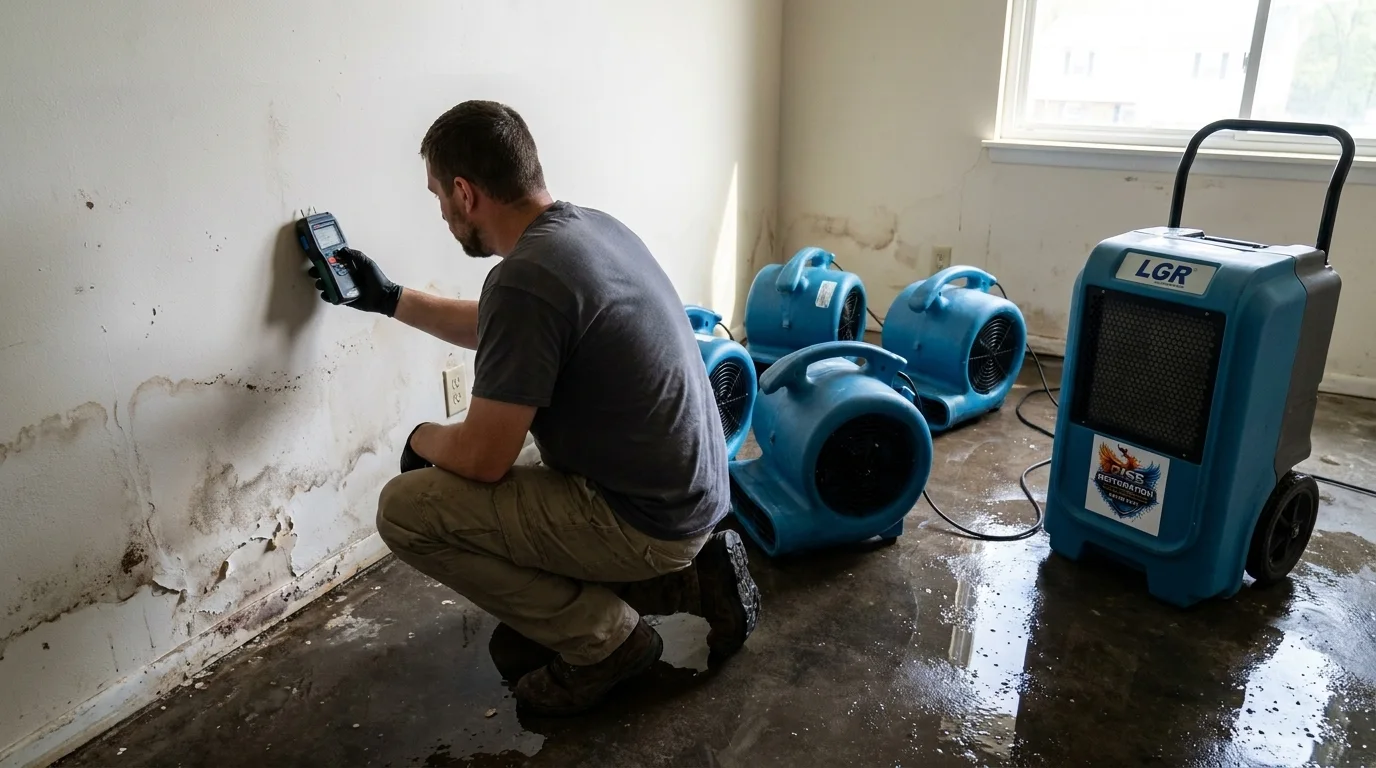
We start with a moisture assessment using penetrating and non-penetrating meters to find out how far water has traveled, which matters more in plaster-wall homes than in newer drywall construction because plaster can look dry at the surface while the lath behind it stays wet. Extraction comes next, pulling standing water from flooring, subfloor, and basement slabs before it has a chance to wick further into framing. Once the bulk water is gone, we set up structural drying equipment calibrated to the materials involved, dried in line with the IICRC S500 standard rather than on a fixed timeline, because a plaster wall in a 1910 New Wilmington home dries at a different rate than drywall in a newer build on the edge of town. Our crews carry IICRC Water Damage Technician and Applied Structural Drying training, so decisions about what to tear out versus dry in place are based on moisture readings, not guesswork.
Reaching New Wilmington from Farrell
Our base in Farrell puts us a short drive from New Wilmington along Route 18 and the connecting county roads, which matters when standing water is spreading by the hour. We dispatch to the borough itself as well as the surrounding township, including properties near the Westminster College campus and the more rural addresses where a longer private driveway or gravel lane can affect how we stage equipment and hose runs. Calling as soon as you spot water, rather than waiting to see if it dries on its own, gives us the best shot at saving flooring and drywall instead of replacing it.
Equipment & Methods We Use for Water Damage
Water extraction relies on truck-mounted and portable extraction units depending on how deep the water is and where it’s pooled, followed by low-grain refrigerant dehumidifiers and air movers positioned to pull moisture out of wall cavities and subfloor, not just off the surface. In homes with plaster walls, we often use injection drying systems to move air directly inside the wall cavity rather than removing the plaster outright, which can save on reconstruction costs. Moisture is tracked daily with meters and, where needed, thermal imaging, so drying stops when the materials actually test dry, not on an estimated schedule.
Local note
A good number of New Wilmington’s older homes near the college were converted into rental housing at some point over the decades, often with plumbing updates done piecemeal rather than all at once. That means a single house can have a mix of galvanized, copper, and PEX lines, and a leak in one section doesn’t tell you much about the condition of the rest. When we’re called to one of these properties, we check the full run of exposed piping in the basement or crawlspace while we’re already on site, since a second leak showing up a month later is a pattern we see often enough to watch for.
If water is spreading through your New Wilmington home right now, the fastest path to limiting the damage is a phone call, not a search for the right contractor. DISS Restoration is set up to move quickly on water damage restoration in New Wilmington, with crews trained to work around the borough’s older construction instead of treating every house the same way.
Serving New Wilmington from our Farrell headquarters — ★ 4.6 · 87 Google reviews
“Very professional, prompt, hardworking, and honest people!” — Bobby, October 2026Read our reviews on Google →
Water Damage Restoration in New Wilmington: Service Coverage
Frequently Asked Questions
How fast can you arrive for water damage restoration in New Wilmington?
How fast can DISS Restoration reach a New Wilmington home from your Farrell base?
Do New Wilmington's older plaster-wall homes dry differently than newer construction?
Are homes near Westminster College more prone to plumbing-related water damage?
What causes burst pipes in New Wilmington during the winter?
Will DISS Restoration work with my insurance company for a New Wilmington claim?
Water Damage Restoration response in New Wilmington
Most New Wilmington calls see a technician on-site within 60 minutes from our Farrell headquarters.