
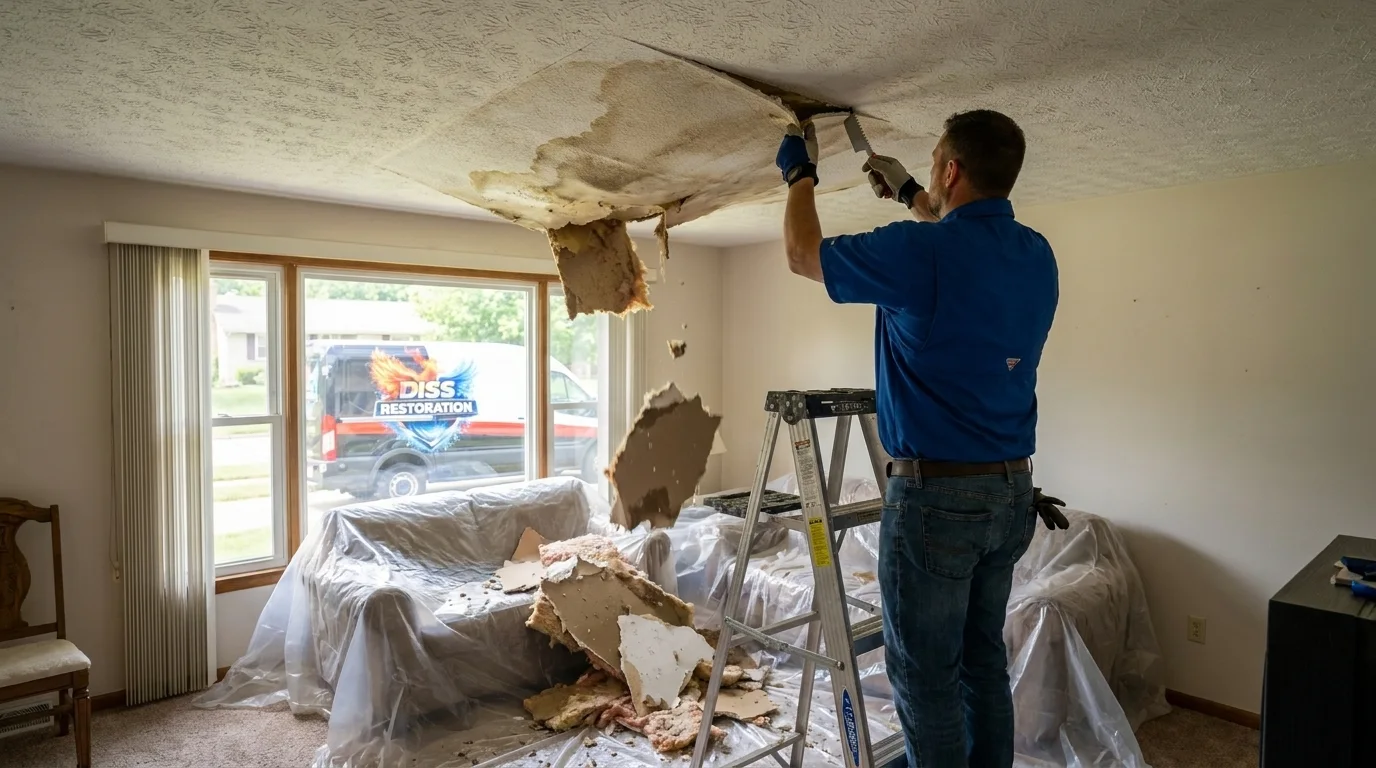
24/7 Emergency Ceiling Water Damage Repair in Farrell
24/7 emergency ceiling water damage repair in Farrell and surrounding areas. IICRC-certified, insurance billing accepted. Call (724) 981-1441.
Water coming through your ceiling in Farrell? A ceiling leak rarely stays a ceiling problem for long. Call (724) 981-1441 and we answer 24/7 to start the assessment before a soft spot becomes a collapse.
A brown ring on drywall, a bubble in the paint, or a ceiling that feels spongy to the touch is usually the visible end of a problem that’s been building in the joist bay above it for days. By the time you see a water stain on the ceiling or notice the drywall sagging under its own weight, the insulation, drywall tape, and sometimes the framing have already absorbed more water than the surface shows. Ignoring it doesn’t buy time, it buys mold colonization, because wet cellulose and gypsum sitting inside a dark cavity start supporting growth within 24 to 48 hours.
What ceiling water damage repair actually involves
This isn’t drywall patching. A proper ceiling water damage repair starts with finding where the water is actually coming from, which is often not directly above the stain. Water travels along joists, truss chords, and the top of insulation before it drips through at the lowest point, so a stain near a hallway light fixture might trace back to a bathroom supply line or roof flashing ten feet away. Once the source is controlled, the work splits into two tracks: drying the structural cavity (joists, subfloor above, insulation) and repairing or replacing the damaged ceiling material itself, which can mean anything from a small drywall patch to a full sheet tear-out if the paper facing has delaminated or the panel has sagged past the point of saving.
Equipment on a ceiling leak job typically includes a moisture meter to map the wet area beyond what’s visible, a thermal camera to trace the path of the water above the ceiling plane, and air movers or a cavity drying system if the space between ceiling and subfloor needs active airflow. Timeline depends almost entirely on what’s behind the drywall: a small, contained leak caught early might dry in two to three days, while a slow leak that’s been running for weeks can mean saturated insulation that has to come out before drying can even start.
Our process
- Source identification and stop. We trace the leak path above the ceiling, whether it’s a roof penetration, a supply line, or a drain stack, and confirm the source is controlled before any repair work starts.
- Moisture mapping. We use moisture meters and thermal imaging to define the actual wet boundary in the ceiling cavity, which is almost always larger than the visible stain.
- Controlled demolition. Where drywall or insulation is saturated past the point of drying in place, we remove only what’s necessary, cutting to clean, dry material rather than the whole ceiling.
- Structural drying. Air movers and dehumidification target the open cavity and surrounding framing, monitored with daily moisture readings until readings return to a dry standard.
- Rebuild. Drywall, texture, and paint are matched and finished once drying is confirmed, documented with before, during, and after photos for your claim file.
What separates a good ceiling water damage response from a bad one
The most common mistake is treating the stain as the whole problem. A contractor who cuts out a patch, paints over the stain, and leaves without checking the cavity above it is gambling that the insulation and framing dried on their own. They usually didn’t. Adjusters know this too, and a claim that gets reopened three months later because mold showed up behind a “repaired” ceiling is a documentation failure as much as a workmanship one.
Another spot where corners get cut: matching texture and sheen on the repaired section. Ceiling repairs that don’t match the surrounding texture are an easy giveaway of a rushed job, and if the whole room needs repainting to blend a mismatched patch, that cost should be scoped up front, not discovered after the fact. A sagging ceiling that’s been wet long enough to deform should be evaluated for whether the drywall can still carry its own weight once dry, not just patched and hoped for.
What does ceiling water damage repair cost?
Costs vary with the size of the affected area, whether insulation needs replacing, and whether structural framing was exposed to water long enough to need drying or repair. Every loss is different, which is why DISS Restoration provides a written scope before any work begins. Most homeowners insurance policies cover ceiling water damage when the source is sudden and accidental, such as a burst pipe or failed appliance supply line, but typically exclude damage from long-term neglected leaks or roof maintenance issues.
| Scenario | Typical range |
|---|---|
| Small stain, surface dry-out only | $300 - $800 |
| Single room, drywall patch and repaint | $800 - $2,200 |
| Sagging ceiling, drywall replacement with insulation | $1,500 - $4,000 |
| Multi-room ceiling with cavity drying | $3,000 - $7,500 |
| Plaster ceiling repair (older homes) | $2,500 - $6,000 |
| Full ceiling tear-out with framing repair | $5,000 - $12,000+ |
Seasonal & regional considerations
Farrell’s winters bring freeze-thaw cycles that stress attic plumbing runs and roof flashing, which means ceiling leaks tend to spike after a hard freeze when a pipe cracks and isn’t discovered until the thaw lets water move. Older homes in and around Mercer County often still have plaster-and-lath ceilings on the upper floors, which behave differently than drywall: plaster can look intact while the lath behind it has already separated from water weight, so an inspection matters even when the ceiling doesn’t look that bad.
Service area
We handle ceiling water damage repair in Farrell and throughout the surrounding Shenango Valley communities, including Sharon, Hermitage, and Sharpsville.
If water is actively coming through your ceiling, don’t wait for it to stop on its own. Schedule your moisture assessment now at (724) 981-1441 and we’ll trace the source, dry the cavity, and get the ceiling rebuilt before a small stain turns into a collapsed panel.
Services We Handle
- Roof Leak Water Damage
Frequently Asked Questions
Does homeowners insurance cover ceiling water damage repair?
How do I know if my sagging ceiling is about to collapse?
Why does the water stain show up in a different spot than the actual leak?
Can a ceiling water stain be painted over instead of repaired?
How long does a ceiling cavity take to dry after a leak?
Looking for the best ceiling water damage repair company in Farrell?
DISS Restoration provides ceiling water damage repair in Farrell, PA and the surrounding area, and has served local property owners since 2021. Customers rate us 4.6 out of 5 stars across 87 Google reviews. We answer calls 24/7 — call (724) 981-1441 for immediate help.
Need Ceiling Water Damage Repair now?
We respond 24/7 across Farrell and surrounding PA cities.